
Industrial ammonia refrigeration systems deliver dependable cooling for food processors, cold storage operators, and manufacturers. When refrigeration runs around the clock, efficiency, durable equipment, and practical maintenance access directly affect the cost of doing business.
Ammonia has served industrial facilities across the United States for more than a century. Its appeal remains straightforward: effective heat transfer, machinery built for demanding service, and a mature network of experienced operators and technicians.
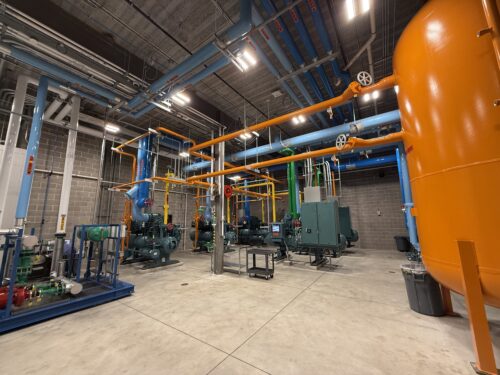
A centralized machinery room from Kuhlman’s cold storage and food distribution project gallery. Photo: Kuhlman Incorporated
Efficiency That Lowers Operating Costs
Brake horsepower per ton of refrigeration, or BHP/TR, measures compressor shaft power for each ton of cooling. Lower BHP/TR means less shaft power for the same cooling capacity. It gives owners a useful starting point for comparing equipment at clearly stated operating conditions.
Kuhlman’s published 100-ton example uses 1.026 BHP/TR for ammonia at 95°F condensing and 1.820 BHP/TR for synthetic R-449A at 110°F condensing. Both use a 26°F suction temperature. That equals 102.6 versus 182.0 BHP, or approximately 44% less compressor shaft power for the ammonia selection.
The lower ammonia condensing temperature contributes to that difference. This is a comparison of two system selections, not a universal refrigerant-only advantage. Annual electrical savings also depend on motor efficiency, pumps, fans, operating hours, and changing loads.
Efficient Heat Transfer and Robust Equipment
Ammonia’s high latent heat of vaporization helps explain its industrial appeal. At 20°F, it absorbs approximately 553 Btu per pound as it boils. That allows a relatively small refrigerant mass flow to carry a substantial cooling load. Strong heat-transfer performance supports efficient evaporator and condenser design, although overall efficiency still depends on the complete system.
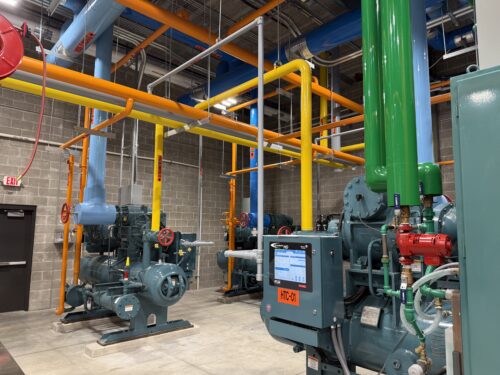
Multiple compressors with accessible motors, valves, and piping in a Kuhlman project. Photo: Kuhlman Incorporated
Multiple compressors with accessible motors, valves, and piping in a Kuhlman project. Photo: Kuhlman Incorporated
Industrial ammonia plants commonly use field-serviceable screw or reciprocating compressors, ASME pressure vessels, and welded steel piping. Equipment can be selected for overhaul and long-term service, with room to reach motors, valves, and major components. Those details make ammonia refrigeration service more practical when production depends on continuous cooling.
Many synthetic refrigerant and CO₂ racks and condensing units follow the compact packaged layouts familiar in commercial refrigeration. Matching cooling tonnage alone does not establish equivalent construction, rebuild options, or service access. Industrial-grade alternatives exist, so owners should compare the actual equipment and installation layout.
Expansion Planned Into the Installation
A custom ammonia industrial refrigeration installation can account for future growth from the beginning. Additional compressors, evaporators, and condensers can be connected in parallel when headers, vessels, utilities, controls, and available space are sized for the added load.
This modular approach can preserve useful infrastructure as production or storage capacity grows. A packaged system that reaches its design limit may need another rack or condensing unit, with additional power, piping, and controls. Packages can also be planned for expansion, but that flexibility should be established before purchase.
Location matters, too. A machinery room with planned lifting and service clearances can make major repairs easier than work inside a compact enclosure or on a rooftop.
Understanding the CO₂ Tradeoffs
Transcritical CO₂ deserves careful evaluation, particularly in warm climates. High-side operating pressures can reach 1,500 psig or higher in some designs and conditions. By comparison, ammonia condensing at 95°F operates at approximately 180 psig. CO₂ therefore requires pressure-rated components, appropriate controls, and service procedures suited to its operating characteristics.
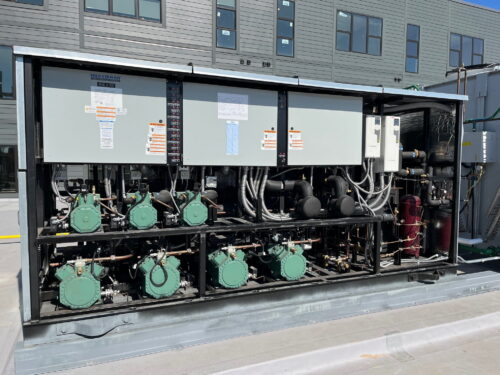
A transcritical CO₂ rack integrates multiple compressors and controls into a compact frame. Photo: Hussmann Corporation
A transcritical CO₂ rack integrates multiple compressors and controls into a compact frame. Photo: Hussmann Corporation
Warm-weather performance depends on the CO₂ system design and heat-rejection conditions. Parallel compression, ejectors, and adiabatic gas cooling can improve performance, while adding equipment or control functions to evaluate and maintain. A fair comparison should consider annual energy use, maintenance access, and the technicians available to support the plant.
For owners seeking a familiar, robust central plant, industrial ammonia refrigeration systems offer an established approach. The value comes from the combination of efficient operation, serviceable equipment, and a design that can accommodate the facility’s future needs.
Experienced Operators and Long Term Support
Ammonia remains deeply embedded in the industrial refrigeration workforce. Many plant operators and service technicians have built their careers around these systems, supported by training through organizations such as RETA and IIAR. That experience is a practical advantage for troubleshooting, planned maintenance, and ammonia refrigeration service.
Kuhlman Incorporated has engineered, installed, and serviced industrial refrigeration systems since 1957. A custom ammonia industrial refrigeration installation brings that field experience into decisions about capacity, equipment access, and expansion. Continued ammonia refrigeration service helps owners maintain performance as operating demands change.
Planning a new facility or expanding an existing plant? Contact Kuhlman to discuss a custom ammonia industrial refrigeration installation built around your operation.