Skip to Content
Exit

Author Archives: Kuhlman Team

  1. Custom Refrigeration for Your Food and Beverage Facility

    Comments Off on Custom Refrigeration for Your Food and Beverage Facility
    Click to ExpandCustom-Refrigeration-for-Your-Food-and-Beverage-Facility

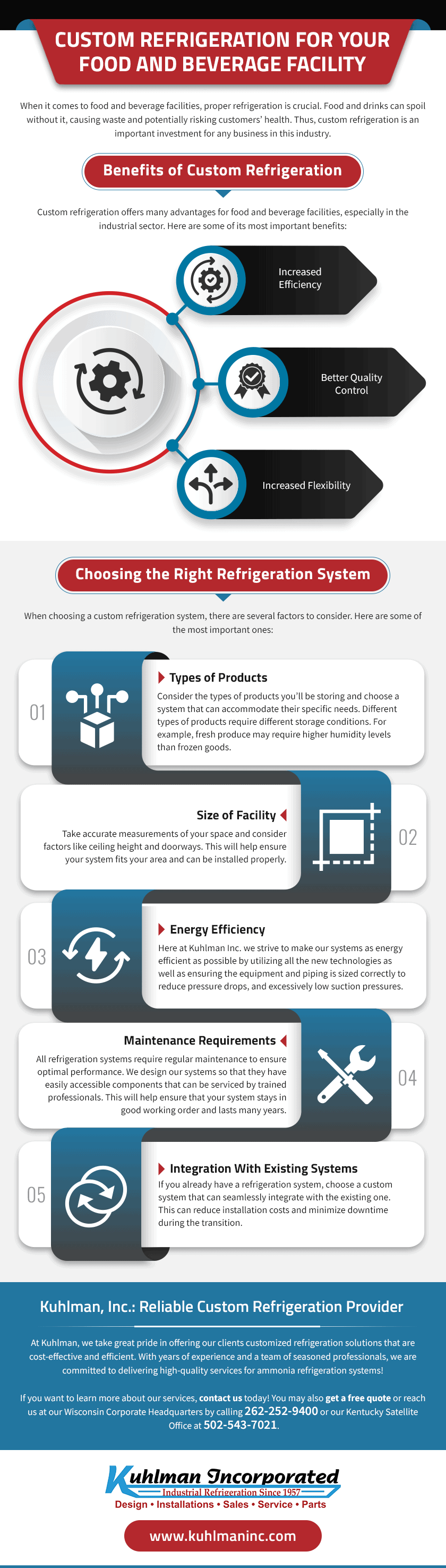
    When it comes to food and beverage facilities, proper refrigeration is crucial. Food and drinks can spoil without it, causing waste and potentially risking customers’ health. Thus, custom refrigeration is an important investment for any business in this industry.

    This article will discuss the benefits of custom refrigeration and how to choose the right system for your industrial food and beverage facility.

    Benefits of Custom Refrigeration

    Custom refrigeration offers many advantages for food and beverage facilities, especially in the industrial sector. Here are some of its most important benefits:

    Increased Efficiency

    Custom refrigeration systems are designed to fit your specific needs. This means they can be more efficient than off-the-shelf systems, which may not be optimized for your facility. In addition, custom systems can be designed to work with your space and operations, reducing energy consumption and saving you money on utility bills.

    Better Quality Control

    Custom refrigeration can help ensure that your products are stored at the right temperature and humidity levels, prolonging their shelf life and preventing spoilage. This means that your customers will receive high-quality products, and you’ll minimize waste and potential health risks.

    Increased Flexibility

    Off-the-shelf refrigeration systems may not be flexible enough to accommodate changes in your facility or product line. With our custom refrigeration systems, you can design a system that can adapt to your changing needs. Whether expanding your facility, adding new products, or changing your workflow, a custom system can be designed to grow and transform with your business.

    Choosing the Right Refrigeration System

    When choosing a custom refrigeration system, there are several factors to consider. Here are some of the most important ones:

    Types of Products

    Consider the types of products you’ll be storing and choose a system that can accommodate their specific needs. Different types of products require different storage conditions. For example, fresh produce may require higher humidity levels than frozen goods.

    Size of Facility

    Take accurate measurements of your space and consider factors like ceiling height and doorways. This will help ensure your system fits your area and can be installed properly.

    Energy Efficiency

    Here at Kuhlman Inc. we strive to make our systems as energy efficient as possible by utilizing all the new technologies as well as ensuring the equipment and piping is sized correctly to reduce pressure drops, and excessively low suction pressures.

    Maintenance Requirements

    All refrigeration systems require regular maintenance to ensure optimal performance. We design our systems so that they have easily accessible components that can be serviced by trained professionals. This will help ensure that your system stays in good working order and lasts many years.

    Integration With Existing Systems

    If you already have a refrigeration system, choose a custom system that can seamlessly integrate with the existing one. This can reduce installation costs and minimize downtime during the transition.

    Kuhlman, Inc.: Reliable Custom Refrigeration Provider

    At Kuhlman, we take great pride in offering our clients customized refrigeration solutions that are cost-effective and efficient. With years of experience and a team of seasoned professionals, we are committed to delivering high-quality services for ammonia refrigeration systems!

    If you want to learn more about our services, contact us today! You may also get a free quote or reach us at our Wisconsin Corporate Headquarters by calling 262-252-9400 or our Kentucky Satellite Office at 502-543-7021.

  2. Food and Beverage Refrigeration Cooling System Considerations

    Comments Off on Food and Beverage Refrigeration Cooling System Considerations

    When running a successful food and beverage business, one of the most important aspects to consider is the proper storage and preservation of your products. This is where a refrigeration cooling system comes into play. To ensure that your food and beverages are stored at the correct temperature, it’s crucial to invest in a high-quality solution that meets your specific needs.

    A well-functioning refrigeration system can reduce food waste, increase efficiency and productivity, and ultimately improve your business sales. In this post, we will delve into the key considerations when choosing a refrigeration system for your food and beverage business.

    Type of Refrigeration Cooling System

    Investing in high-quality refrigeration cooling systems is an important part of assuring the performance and profitability of food and beverage processing companies. Food processing businesses can select appropriate cooling systems like ammonia or freon to balance efficiency and environmental impact. Using these refrigeration systems saves energy and helps businesses contribute to a cleaner environment by reducing greenhouse gas emissions.

    Capacity and Size

    The size of your business will determine the capacity and size of the refrigeration cooling system you require. It is also affected by the amount of food or beverages you need to store. Therefore, one of the first steps when choosing a refrigeration system is understanding the demands of your business. It’s critical to invest in a refrigeration system that’s large enough to satisfy your needs. However, a system that is too big can become inefficient and costly.

    Energy Efficiency

    Evaluating a refrigeration system’s energy efficiency can help you save money on energy expenditures while reducing your environmental footprint. Think about features like variable-speed compressors and electronic controls. These will allow you to adjust or calibrate your system to cool and function only as required. We can provide options and breakdown cost paybacks for various energy efficiency investments. We strive to have our systems be as energy efficient as possible.

    Maintenance and Repairs

    It is critical to evaluate the refrigeration system’s maintenance and repair requirements to know what expenses you might encounter in the future. Some components may need more regular maintenance and repairs than others. At Kuhlman Inc., we can provide the exact PM program necessary to keep your system up to date and operating in its best condition.

    Price and Budget

    While investing in a high-quality unit is critical, it is equally vital to avoid overspending. Therefore, setting a budget is an important part of the process. Then, it is best to evaluate and compare the most cost-effective options and select the system with the highest return on investment.

    At Kuhlman Incorporated, we prioritize providing customers with various options accompanied by detailed energy savings analysis and capital cost investment.

    Kuhlman Inc.: Leading the Way in Industrial Refrigeration Cooling System Technology

    Choosing the most suitable refrigeration system for your food and beverage business is critical for product preservation and quality. By carefully considering these factors, you can guarantee that you invest in a system that matches your requirements and helps your business thrive.

    Kuhlman, Inc. is at the forefront of innovation in industrial refrigeration systems’ design, installation, and service! Our team of experts is dedicated to providing you with the most advanced and efficient solutions for your specific needs. We can also help you find the best unit to fit your budget, application, and preferences.

    Contact us today for all your industrial refrigeration demands!

  3. Safety Management of Ammonia Refrigerant Systems

    Comments Off on Safety Management of Ammonia Refrigerant Systems
    Click to ExpandSafety-Management-of-Ammonia-Refrigerant-Systems

    Ammonia refrigeration is along standing form of refrigeration that is still commonly used today to keep various products cold. This method of refrigeration is popular due to its reliability, efficiency, safety, and proven usefulness. Because of these benefits, ammonia refrigeration is utilized by a wide range of industrial facilities, such as:

    • Meat, poultry, or fish processing plants
    • Cold storage warehouses and ice plants
    • Dairy and ice cream plants
    • Fruit/vegetable juice and soft drink processing facilities
    • Wineries and breweries
    • Chemical manufacturing facilities

    Although ammonia refrigeration is safe when properly used, accidental ammonia leaks or releases can pose serious injuries and even death to employees, emergency response personnel, and people in the surrounding environment. To avoid this, there are many requirements and standards that facilities must meet to ensure safe conditions.

    Hazards of Ammonia

    An accidental release of ammonia sometimes produces a dense, visible white cloud that travels close to the ground. However, if there is no visible cloud, the odor itself will prompt the necessity of evacuation, either inside or outside.

    The odor becomes evident when 5 to 50 parts per million (ppm) of ammonia is released. At this level, it is toxic, causing symptoms like headaches, loss of smell, nausea, and vomiting. Emissions of above 50 ppm produce irritation of the nose, mouth, and throat, resulting in coughing and wheezing. Exposure to 300 ppm to 500 ppm of ammonia can be fatal, causing extreme shortness of breath and even fluid buildup in the lungs. Other side effects include frostbite and chemical burns to the skin, eyes, and lungs.

    Another major hazard of ammonia is its flammability. If there has been a leak of ammonia, just an electric spark from a switch could produce an explosion or fire.

    Ammonia Safety Requirements

    Because of ammonia’s many hazards, various associations have outlined standards of ammonia refrigeration safety. These include:

    IIAR

    IIAR is the world’s leading advocate for the safe, reliable and efficient use of ammonia and other natural refrigerants. IIAR members share their collective knowledge and experience to produce consensus documents that address various aspects of the natural and industrial refrigeration industry. IIAR has broad industry representation including manufacturers, design engineers, contractors, end users, academics, scientists, and trainers. IIAR sets the standard for providing advocacy, education and the most up-to-date technical information to the ammonia and natural refrigeration community.

    OSHA

    If your ammonia refrigeration system has 10,000 pounds (2,000 gallons) or more of ammonia, it is subject to the requirements of OSHA Process Safety Management (PSM) Standard [29 CFR 1910.119].

    EPA

    The EPA has published documents that outline the responsibilities of ammonia refrigeration operators when it comes to preventing accidents. According to the Clean Air Act, owners and operators are required to develop Risk Management Programs that are designed to prevent or reduce the consequences of accidental ammonia releases. Additionally, plants or facilities that store large amounts of ammonia (more than 500 pounds) must report and coordinate with their Local Planning Committee as well as their State Emergency Commission.

    Department of Homeland Security (DHS)

    The DHS requires high-risk chemical facilities to develop site security plans, complete security vulnerability assessments, and implement the necessary protective measures to meet risk-based performance standards defined by the DHS.

    Ammonia Safety and Accident Prevention

    According to the EPA, 96% of ammonia-related accidents are preventable through better communication, improved procedures, and enhanced operator training. To make sure that accidents don’t happen, it’s important to implement the following:

    Worker and System Protection

    Training and awareness of the hazards associated with anhydrous ammonia will lead to greater care to prevent ammonia releases. Developing operating procedures that follow RAGAGEP, such as the ANSI/IIAR standard 7-19, will help keep personnel safe. Other steps you can take to protect your workers and systems include:

    • Oil removal
    • Protect equipment, tanks, and piping
    • Install, maintain, and inspect ammonia detector systems
    • Install emergency ventilation switches
    • Configure remote operation of solenoid valve on king valve line
    • Install check valves in the ammonia charging line
    • Install dual pressure relief valves
    • Color coding, labeling, and signage

    System Operations and Maintenance

    You should implement a mechanical integrity plan for each component of your ammonia refrigeration system. To ensure compliance with 40 CFR 68.73, these procedures must be written and regularly performed to ensure the ongoing integrity of process equipment. ANSI/IIAR standard 6-19 spells out minimum requirement, some of the common system operation and maintenance procedures include:

    • Monitor refrigeration system operating parameters
    • Maintain good housekeeping practices
    • Maintain piping and instrumentation diagrams
    • Track ammonia purchases and distribution of ammonia in your system
    • Conduct a periodic process hazard analysis

    System Inspections

    In addition to preventive maintenance measures, scheduled inspections should be performed to prevent unnecessary accidents from equipment failure. Systems inspections include:

    • Visual testing
    • Leak testing
    • Vibration testing
    • Thermal imaging

    Training

    Operators of ammonia systems should be fully trained and qualified. Personnel who work within these areas should be provided with awareness training, such as safety and evacuation procedures, should a leak occur.

    Proper Security

    Ammonia theft and vandalism of ammonia storage and refrigeration systems have resulted in the accidental release of ammonia. Installing site security safeguards is another form of prevention.

    Ammonia Safety at Kuhlman, Inc.

    Ammonia refrigeration systems offer a safe and reliable way to keep products cold as long as you adhere to ANSI/IIAR standard 9-20 RAGAGEP. At Kuhlman, Inc., we can deliver refrigeration systems that meet the needs of various industries. To discuss your specific refrigeration requirements with one of our expert team members, contact us or request a quote today.